Datasets & Code

Open data and reproducible code

We share datasets, trained models and analysis code to support open, reproducible hydrology.

Our Zenodo community

All our datasets in one place

Browse the EcoHydroLab community on Zenodo — every dataset we release, with DOIs, versioned records, and direct downloads, collected in a single open repository.

Flagship dataset

CAMELS-IND

Catchment Attributes and Meteorology for Large-sample Studies – India. Daily meteorological time series, observed and LSTM-predicted streamflow, and static catchment attributes for 472 catchments in Peninsular India — designed to foster large-sample hydrological studies and bring Indian catchments into global research.

472
catchments
Daily
time series
ESSD
peer-reviewed
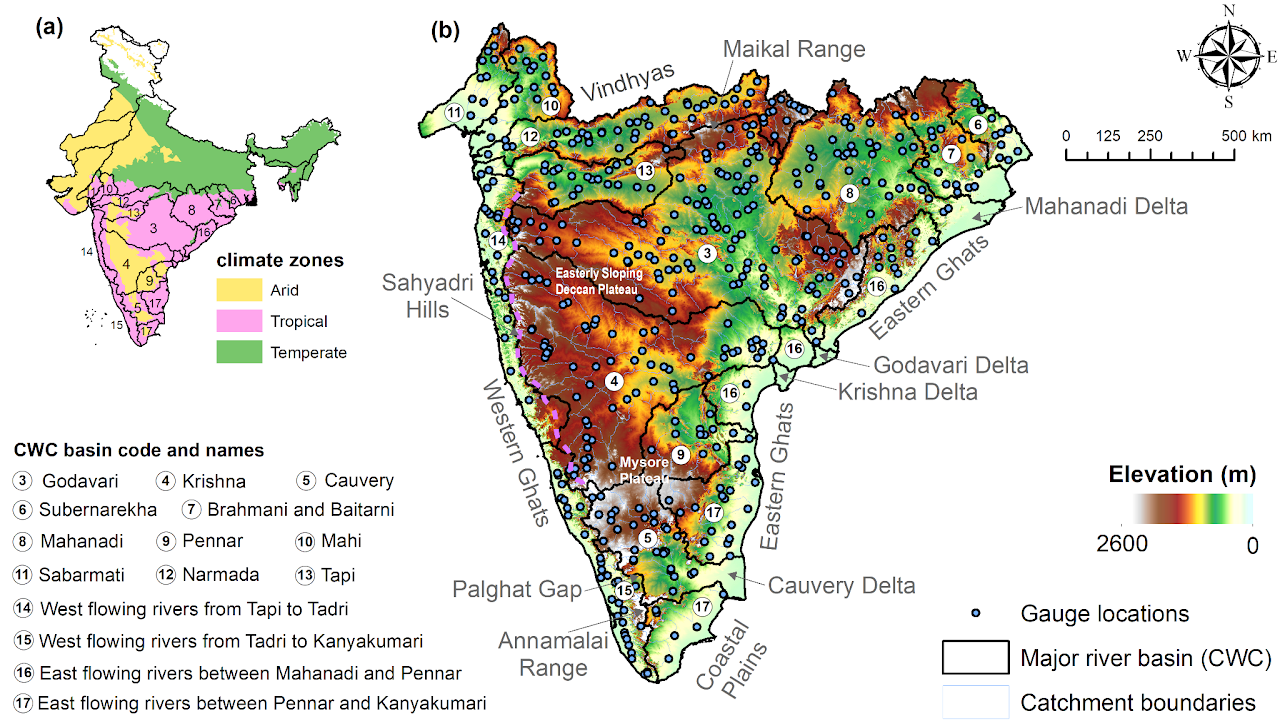
Overview schematic of the CAMELS-IND dataset showing catchment locations, meteorological forcing time series, and catchment attributes across Peninsular India
CAMELS-IND dataset catchment locations.
Companion dataset

CAMELS-IND-Proj

Catchment Attributes and MEteorology for Large-sample Studies – India – Projected Streamflow. Provides meteorological forcings and projected daily streamflow for the same 472 Peninsular Indian catchments as CAMELS-IND, under future climate scenarios — extending large-sample hydrological research in India into a changing-climate context.

472
catchments
13
CMIP6 GCMs
4
SSP scenarios
2015–2100
projection period

Same 472 catchments

Uses the identical Peninsular India catchment set as CAMELS-IND, keeping the two datasets directly comparable.

13 CMIP6 GCMs

Projected streamflow simulated across a diverse multi-model ensemble of General Circulation Models.

4 SSP scenarios

Covers SSP126, SSP245, SSP370 and SSP585 — a full range of shared socioeconomic pathways.

Future & historical streamflow

Daily projected streamflow (cumecs) for 2015–2100 under each scenario, plus historical-period simulations for each GCM.

Meteorological forcings

Precipitation, maximum temperature and minimum temperature, provided for both historical and future periods under each GCM and SSP scenario.

Daily time scale

All streamflow and forcing variables are provided at daily resolution, matching the CAMELS-IND standard.

Other Code & Data

Data, Models & Software

Sharing our model codes, data, results and analysis notebooks.

MM_Ensemble-for-Flood-Mapping

A Novel Multi-Model Ensemble Framework for Fluvial Flood Inundation Mapping. This code contains machine learning-based multi-model ensemble framework for fluvial flood inundation mapping.

Differentiable hybrid models

Differentiable Parameter Learning (dPL) + HBV Hydrologic Model with Reservoir Module. In this version, we have extended the model by incorporating a reservoir module, enabling simulation of regulated catchments. This enhancement allows the model to better represent flow dynamics influenced by reservoir operations.

PIDuaL: Physics-Informed Dual-Output LSTM

PIDuaL is an extension of the Mass-Conserving Long Short-Term Memory (MC-LSTM) model for hydrological modeling. It enables the simultaneous prediction of streamflow and evapotranspiration through a modified water-balance structure.

Benchmarking Conceptual Rainfall–Runoff Models

This dataset accompanies the manuscript “Benchmarking and Selecting Optimal Hydrological Models for Large-Sample Applications Considering Complexity and Uncertainty” (Mangukiya et al., under review, Water Resources Research). It provides simulated streamflow outputs and evaluation metrics for 47 conceptual rainfall–runoff models applied across 159 watersheds in Peninsular India.

Net Primary Productivity (NPP) data

Monthly, Seasonal and Yearly Net Primary Productivity (NPP) data of India from 2003-2020 modelled using the CASA model.